

WHY WE REJECTED VENTILE
We wanted to see whether Ventile could bring natural weather protection, durability and a better hand-feel to the three season Trouser. It had many of the qualities we were looking for — but one fundamental problem. It didn’t move. Here’s why we tested it, why we rejected it, and what it taught us about building performance clothing without compromising our material philosophy.
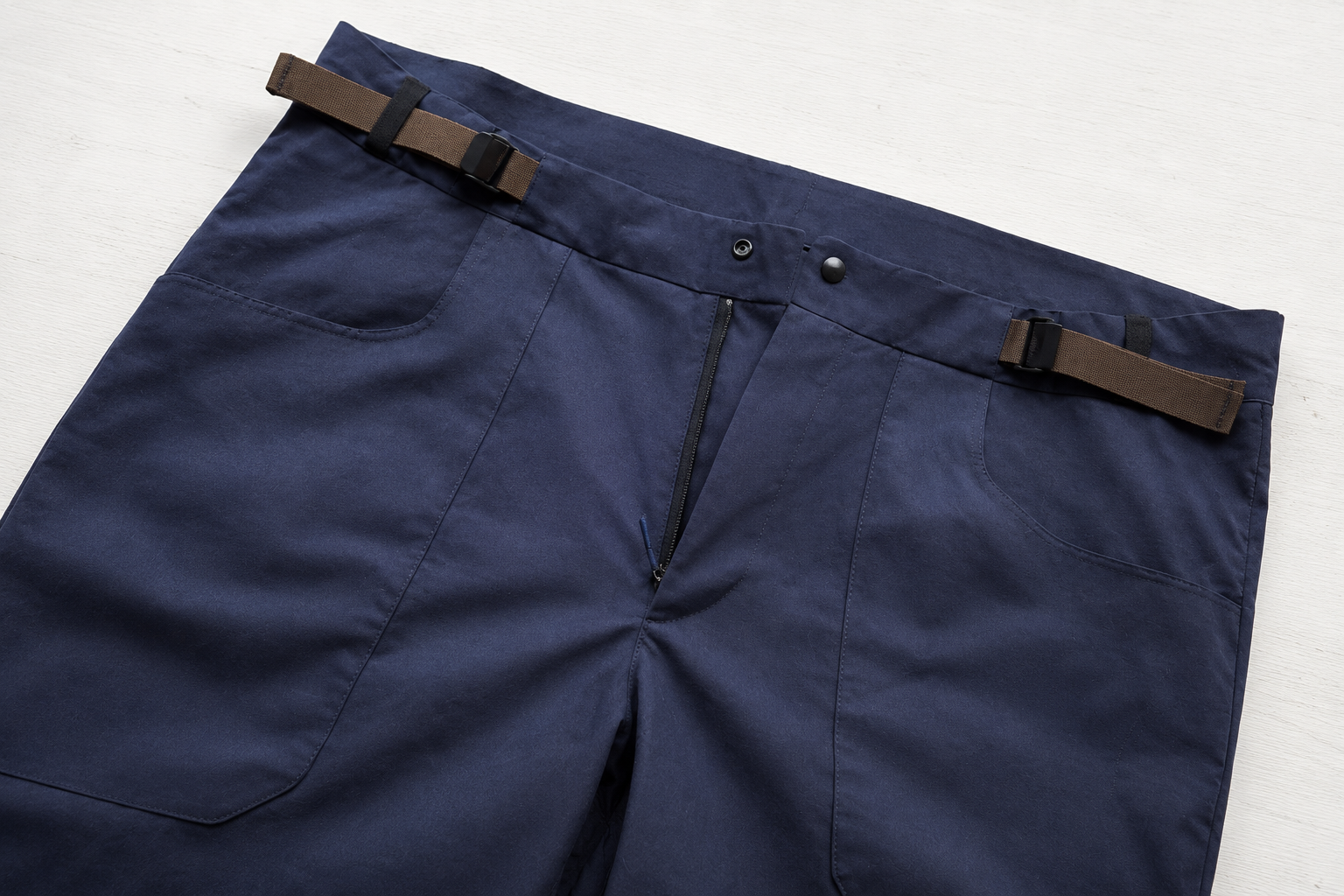
# WHY WE REJECTED VENTILE
Sometimes product development is as much about discovering what doesn't work as finding what does.
When we started developing the Three season Trouser, one of the first fabrics we wanted to explore was Ventile.
On paper, it made a lot of sense.
## WHY VENTILE?
Ventile has an unusual history.
Originally developed in Britain, it is a densely woven cotton fabric designed to provide significant weather protection without relying on a conventional synthetic waterproof membrane.
That immediately interested us.
We're trying to use natural fibres wherever they can genuinely do the job. Not because we're against technical fabrics, but because we believe natural materials can often provide a better feel, quieter performance and a garment you actually want to wear away from the course.
Ventile offered many of those qualities.
It has a dry, substantial hand. It doesn't look shiny or overly technical. It ages rather than simply wearing out. And its tightly woven construction provides a useful degree of protection from wind and rain.
For a trouser designed for golfers who walk in changing British conditions, there was enough there that we felt we had to try it.
So we did.
## THE PROBLEM
The moment we started looking at how it would actually work as a golf trouser, one issue became difficult to ignore.
Movement.
Traditional Ventile has very little inherent stretch.
For some garments, that isn't a problem.
For the Trouser, it was a non-starter.
A golf trouser has to move through a full swing. It needs to work when you're walking 18 holes, crouching to read a putt, climbing a bank, stepping into a bunker or carrying a bag for four or five hours.
You shouldn't be conscious of the trouser fighting against you.
We could have tried to design around the limitations of the fabric with additional volume, panels or more complicated construction.
But that would have been solving a problem we'd created ourselves.
So we rejected it.
## NATURAL DOESN'T AUTOMATICALLY MEAN BETTER
This was an important early lesson for HOLDFAST.
We want to push towards natural materials wherever possible.
But material philosophy can never come ahead of performance.
If a beautiful natural fabric compromises the way a golfer moves, it's the wrong material.
Equally, if using a small proportion of synthetic fibre produces a dramatically better-performing garment, we'll consider it.
The objective isn't to create clothing that satisfies a material checklist.
It's to build the best golf clothing we can.
## THAT'S WHY WE PROTOTYPE
There would have been an easier way to develop the Trouser.
Find an established stretch performance fabric. Choose a colour. Make a sample.
But we'd learn very little doing that.
We want to question the materials golf clothing is normally made from and understand where there might be a better answer.
Sometimes that means finding something worth pursuing.
Sometimes it means discovering very quickly why something doesn't work.
Ventile didn't make it into the three season Trouser.
But testing it helped define what the trouser needed to become.
And that's exactly what a prototype is supposed to do.